
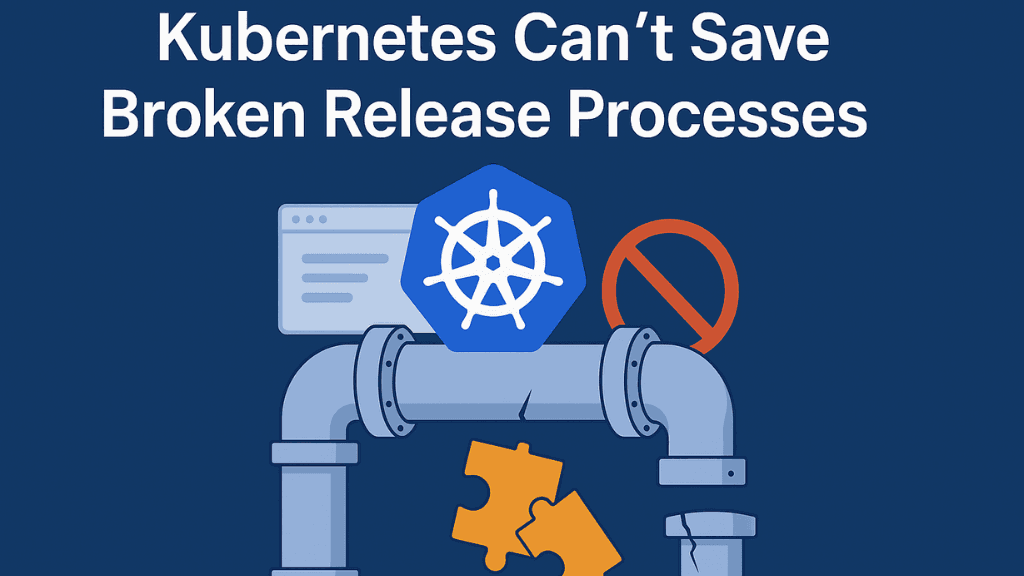
Every time a release goes wrong, teams blame everything except the real issue.
The cloud provider. The cluster. The YAML. The pods. The “weird” behavior of Kubernetes.
But here’s the uncomfortable truth
Kubernetes is not your problem.
Your release process is.
And no number of clusters, operators, service meshes or autoscaling magic will save a pipeline that is already fundamentally broken.
The Illusion of Safety
Kubernetes gives teams a false sense of control.
They see
Containers running
Pods restarting
Deployments rolling out
And assume the system is healthy.
But healthy infrastructure does not mean healthy releases.
Teams often confuse
Infrastructure automation
with
Release reliability.
Two completely different things.
The Real Problems Start Much Earlier
When releases fail, it’s rarely Kubernetes.
It’s everything that happens before your code ever touches the cluster.
Common culprits
- No clear branching strategy
- Lack of automated testing
- Missing environment parity
- Overly manual approvals
- Poorly defined rollback paths
- No observability tied to releases
- Releases happening from laptops instead of pipelines
- Important config changes hidden inside the repo with no traceability
This is where releases break.
Kubernetes simply exposes the cracks.
Why Kubernetes Makes Bad Processes Worse
Kubernetes is powerful, but unforgiving.
When your release process has weaknesses, Kubernetes magnifies them.
- You deploy bad configuration, it fails instantly
- You ship untested code, autoscaling won’t save it
- You push large images, startup times explode
- You mix configs per environment, pods behave unpredictably
- You skip SRE principles, you drown in incidents
Kubernetes is automation, not a band aid.
Modern Releases Require Modern Discipline
If you want stability, you need more than clusters.
You need a release culture that supports reliability.
What great teams do
- Treat releases as a product
- Add automated tests at every stage
- Maintain strict CI pipelines with zero-point-of-failure
- Enforce peer reviews and environment parity
- Use progressive delivery tools like Argo Rollouts
- Adopt feature flags for safe experimentation
- Connect observability directly to deployments
- Maintain repeatable rollback workflows
Kubernetes becomes powerful only when releases are predictable.
The Business Cost of Broken Releases
When processes fail, the financial damage is real.
- Slow releases hurt your speed to market
- Frequent incidents kill customer trust
- Developer’s waste hours debugging environments
- Product teams delay launches
- Infrastructure cost increases from unpredictable workloads
Broken releases aren’t just a technical problem.
They are a business problem.
So, Can Kubernetes Save You
No.
Kubernetes is the jet engine.
Your release process is the pilot.
If your process is reckless
The engine only makes you crash faster.
How BrainerHub Helps Fix Release Chaos
If your team is stuck in slow, unpredictable or painful releases, our DevOps engineers fix the foundation first, not the tools.
We help you
- Build CI pipelines that never lie
- Standardize environments across staging and production
- Create reliable automated test suites
- Implement canary, blue green and progressive rollouts
- Set up GitOps workflows with ArgoCD
- Build real rollback strategies with zero downtime
- Connect logs, metrics and traces directly to releases
- Prevent release failures instead of reacting to them
Most teams think they need better Kubernetes.
What they really need is better release engineering.
BrainerHub gives you both
But in the right order.